Style Comparison · Secret Support

Taichou vs Kumo

Two Secret rarity team-oriented styles with completely different roles. Taichou orchestrates offense as a setter; Kumo locks down defense as a libero. Your team needs one — or both.

This page is part of an independent, fan-made Roblox guide site for Volleyball Legends - not affiliated with Roblox Corporation or the game's developers. We compile and clarify community-observed facts to help players make informed decisions.

Taichou vs Kumo: Quick Navigation

Taichou — Secret Setter with Power Set mechanic
Taichou: Secret Setter — Power Set delivers consistent passes with excellent rally pace control.
Kumo — Secret Libero/Support with Moonball Bump
Kumo: Secret Libero/Support — Moonball Bump + Charge Boost for unmatched court coverage.

Taichou and Kumo are both Secret-rarity styles but serve opposite ends of the team spectrum: Taichou is a dedicated setter built around precision and tempo control; Kumo is a libero-style support built around coverage, accuracy, and passive team buffing. Neither is 'better' - they fill fundamentally different roles. To understand how each fits your playstyle, go directly to their dedicated pages:

Key Takeaways at a Glance

Role & Identity

  • Taichou is VBL's original Secret setter - designed for players who want total control over rally pace and spike timing.
  • Kumo is a Secret libero - built for players who prioritize ball recovery, consistent receive, and supporting teammates without needing to score.

Core Mechanics

  • Taichou's Power Set delivers high-accuracy, vertically stable passes that stack spike power - especially strong when paired with spikers like Riku or Sanu.
  • Kumo's Moonball Bump creates reliable, low-risk first touches; its passive Charge Boost grows stronger the longer a rally lasts, making it ideal for extended 6v6 sequences.

Stat Profiles

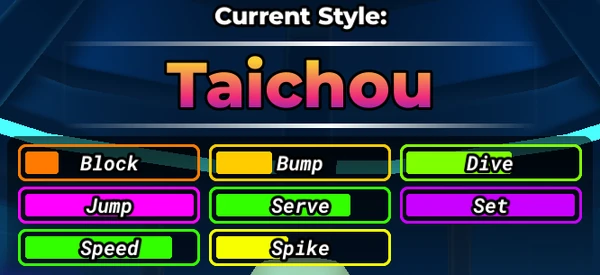
  • Taichou: Jump 100%, Set 100%, Speed 90%, Block 20% - elite setting, fast movement, very weak blocking.
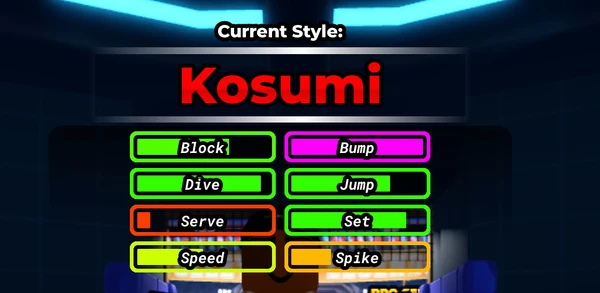
  • Kumo: Max Bump, Max Dive, Max Set, Max Speed - no offensive stats sacrificed, but zero Spike or Serve pressure.
No overlap in team function

You don't choose between Taichou and Kumo based on 'which is stronger.' You choose based on whether your team needs a playmaker (Taichou) or a safety net (Kumo). In coordinated 6v6, both can coexist - Taichou sets, Kumo receives and covers gaps.

When to pick Taichou

Taichou is ideal if you...

  1. Play on teams where at least one teammate consistently spikes - Taichou's Power Set amplifies their damage.
  2. Prefer structured rallies over chaotic scrambles - its set height and consistency reward timing over reflexes.
  3. Want to climb ranked using tempo-based strategies - e.g., using Minus Tempo + Taichou to create unblockable spike windows.
  4. Are comfortable sacrificing personal scoring for team synergy - Taichou has no spike or serve threat.

When to pick Kumo

Kumo is ideal if you...

  1. Often play solo queue or with inconsistent teammates - its Moonball Bump prevents easy points from poor serves.
  2. Prefer maps like Jungle where floor coverage and dive range matter more than net presence.
  3. Want passive scaling without micromanagement - Charge Boost activates automatically as rallies extend.
  4. Value survivability over point-ending plays - Kumo doesn't win points itself, but prevents losses.

Taichou vs Kumo: Role Comparison

Trait
Taichou
Kumo
Rarity
Secret
Secret
Primary Role
Setter
Libero/Support
Core Mechanic
Power Set - reliable, stacked spike setups
Moonball Bump + Charge Boost - accurate receive + rally-scaling buffs
Best Map
All maps (excels in Arena)
Jungle (due to dive/speed coverage)
Team Dependency
High - needs spikers to convert sets
Low - thrives even in disorganized queues
Beginner Friendly?
Medium - requires understanding of set timing
High - intuitive bump/dive combo, forgiving on positioning

Ability Pairing Guidance

Neither style benefits from raw offensive Abilities - both rely on enabling others. Focus instead on Control or Mobility options that reinforce their core identity:

Top Ability Matches

  • Taichou + Minus Tempo: The most dominant setter-spiker combo in ranked - creates fast, angled attack routes that punish late blockers.
  • Taichou + Zero Gravity Set: A safer, more forgiving alternative to Minus Tempo - better for learning set timing before upgrading.
  • Kumo + Extra Touch: Extends rallies further, giving Kumo more time to trigger Charge Boost and teammates more chances to recover.
  • Kumo + Magnetic Pull: Turns awkward bumps into controlled second touches - essential for maintaining rhythm after tough serves.
Avoid these mismatches

Don't pair Taichou with Power Abilities (e.g., Divine Strength) - it has no spike stat to leverage. Don't pair Kumo with Specialist Abilities like Lead Feet - its role is reactive, not momentum-based.

FAQ

Q1

Can I use Taichou and Kumo on the same team?

Yes - and it's highly effective. Taichou handles setting and tempo; Kumo handles first-touch reception and back-row coverage. This pairing appears frequently in top-tier 6v6 squads.

Q2

Which is better for solo queue?

Kumo. Its Moonball Bump and max Dive/Speed make it far more forgiving when teammates miscommunicate or miss blocks. Taichou relies on predictable spike timing that rarely exists in public matches.

Q3

Does Taichou work well with Timeskip Kageyomo?

Yes - Super Set and Power Set complement each other. Taichou provides vertical stability; Timeskip Kageyomo adds horizontal unpredictability. Both excel in coordinated 6v6.

Q4

Is Kumo outdated after Update 77?

No - its core mechanics remain unchanged and highly valued. Community sentiment (VL Wiki, YouTube trend reports) continues to rank it among the top 3 support styles for Jungle and ranked 6v6.

---